Hot Hens


As mentioned earlier in the blog it is very important to always make sure fresh water is available for your hens. Birds cannot sweat therefore overheat a lot easier than humans. Signs of heat stroke include : excessive panting, lethargy, closed eyes, twitching, dark wattles and combs, crouching, raised feathers and spread wings. Not only does egg production go down but the heat can cause the chickens heart and kidneys to swell, with blood becoming thicker their breath rate increases from between 12-30 breaths per minute to 250. Removing layers pellets at around midday when its hottest may help the birds control their temperature as respiration produces heat. Instead, provide the hens with fresh fruit such as watermelon which also helps to keep them hydrated. Summer conditions are perfect for fly's and insects therefore its also important to make sure the bedding is clean as decomposition also generates heat. The most simplest of reasons of overheating can be due to overcrowding, this can make a coop at any time of the year stuffy and uncomfortable.

Breed of the Month- Silkie

The Silkie has a unique 'fluffy' appearance with feathered feet and a tuft of feathers on the head. Some have 'ear muffs' and some have beards. It is an ancient bird originating from Asia and has a walnut comb, dark purple skin and blue earlobes. There are large fowl (which is actually comparatively small compared to other breeds)  and bantam versions of the Silkie. Cockerels have a short back and straggled feathers on the wings with longer legs then the females.

Silkies are gentle birds, but are best kept with their own breed. In addition, the hens easily become broody meaning that most you will get around 100 small eggs a year, making them better for domestic and exhibition purposes. They do not fly well, but easily pick up mud and therefore are susceptible to Scaley Leg mite, so an extra effort must be made to keep them clean and dry.

 Summary: 
  •   Eggs: up to 100 small eggs a year
  • Colourings: Black, Blue, Gold, Partridge, White
  •   Character: Gentle
  •  Weight: Female 1.36 kg, Male 1.8kg


* *IF YOU HAVE ANY MORE INFORMATION ON THIS BREED YOU WOULD LIKE TO ME TO ADD TO THIS POST PLEASE MAKE A COMMENT BELOW*

Tips for Mud Problems

Even in the summer a sudden downpour can quickly yield all the solid dry earth where chickens have scratched at too pools of mud. Earlier in my blog I mentioned use of wood chips and not bark chips as these can become moldy and carry potentially harmful bacteria. However, I've also come across some new suggestions, under these wood chips you can place a 'weed control' mesh this will prevent the chips from being sunken into the ground beneath them. Some keepers are now saying they use rubber chippings as they are long lasting, safe, easy to clean and won't rot or freeze. If anyone uses these chippings please let me know if they are effective! Its important to use chippings if there is little grass as it will encourage the hens natural sense of foraging. In addition, you may choose to put perches outside the coop to try and keep the hens of the ground, you can encourage this by hanging CD's and cabbages near the perch for them to peck at.


Apple Cider Vinegar- A Chickens Miracle Grow!

ACV is produced from red apples containing a rich variety of vitamins and minerals including Potassium, Phosphorous, Iron and vit A, C, E. All these ingredients are known to be a general health booster to your poultry by strengthening their immune system. Because the liquid is slightly acidic, its low pH can aid against infections and parasites. ACV is toxic to Canker for example caused by Trichomoniasis Protozoa. The Potassium also controls the build up of Calcium in the blood vessels which can prevent the production of soft shelled eggs laid by hens. I recommend you use this product and dilute it part 1:10 in clean, fresh water.  This means it wont taste so acidic to put the birds off drinking, but yet they still gain the benefits. Some keepers at poultry shows are also known to dab their chickens feathers with ACV to remove grease and add an attractive sheen, therefore you could use this to clean any clumps of dirt off feathers on your hens. Don't use ACV with metal drinkers as its acidic properties can corrode and damage the containers. For domestic keepers you can get ACV from Pets At Home ACV is £5 for 500 ml, however it is easily bought cheaper in large quantities at about £10 for 5 liters.


Campaign- Production Method Labelling

With the new introduced 'EU laying hens directive' to help hen welfare in egg production by promoting use of 'enriched cages', food manufacturers have started to look elsewhere. This means that business are now looking to other countries or non-compliant production systems in the EU where costs are cheaper and not necessarily where the hens health is kept in mind, and that means battery farming. 

If you have forgotten what battery farming is ....

  • Battery hens often have less 0.6 square feet space in their cages which is smaller then a regular A4 piece of paper.
  •  Their beaks are often removed to prevent them from pecking each other in high stressed and often starving conditions as the manufacturers save money.
  • their cages are indoors, they are packed closely together in artificial light. Their claws often grow painfully long because they aren't allowed outdoors.
  • Manufacturers also save money by forcing the hens to molt (lose their feathers) to promote recovery of the reproductive tract so that the quality of eggs are improved. Although this is not allowed in the UK this is still practiced in other countries. The hens are starved for 2 weeks and given little maybe no water in order to shock their bodies. It is common for up to 10% of hens to die in this cruel process.
  • Hens are killed after 2 years when their egg production begins to drop, the Battery Hen Welfare Trust is a charity that hopes to re-home some of these hens.


Therefore, to try and battle this problem the BHWT along with me is campaigning for "manufactures to add country of origin and production method labelling information to ingredients list by name i.e. Ingredients: barn egg (UK), free-range egg (UK), colony egg (UK), conventional caged egg (non-EU)." 
This information will help inform us consumers where our food has come from and hopefully reinforce to manufacturers how much we believe in hens having a comfortable, free range lifestyle.
To do this we require your help. Please contact your local parliamentary representative with this (sample letter provided by BHWT) or your own letter in support of the campaign:

Dear (PLEASE ADD NAME)
I am writing to seek your support for a British Hen Welfare Trust (BHWT) campaign seeking the implementation of a production method labelling scheme for foods with egg as an ingredient across the EU.
The BHWT supports egg farmers farming to high welfare standards, and wishes to see farming remain strong in the EU where there is a desire to continue to improve welfare standards for laying hens.
The BHWT is concerned about a competitive threat to the EU egg industry (following the implementation of the EU laying hen’s directive) from (a) food products manufactured from eggs produced in non-compliant systems in the EU and (b) food products manufactured from eggs produced in conventional cage systems outside of the EU. The liquid egg and egg products sectors are most at risk of importing and using product, and the most difficult to monitor.
These issues have been highlighted as major areas of concern by the British Egg Industry Council, British Free Range Egg Producers Association, British Egg Products Association, NFU Cymru and a UK parliamentary committee investigating the implications of the welfare of egg laying hen’s directive for the egg industry.  British Egg Industry Council figures suggest it will be cheaper to produce egg powder in countries such as the US and India and export to Europe than to produce within the EU.
To counteract this problem, the BHWT is seeking your support for the implementation of a production method labelling scheme for foods with egg as an ingredient.  Such a scheme will empower consumers with necessary information to support compliant egg farmers from EU member states.
The BHWT proposes such a scheme would require manufactures to add country of origin and production method labelling information to ingredients list by name i.e. Ingredients: barn egg (UK), free-range egg (UK), colony egg (UK), conventional caged egg (non-EU).
If products contain egg from conventional cage systems from outside of the EU this will be marked on the ingredient list. This labelling will minimise the impact of egg product produced in either non-compliant systems within the EU or conventional caged systems outside of the EU, entering the EU and undermining compliant egg farmers, helping to alleviate the problem which has been identified as a threat to the egg industry.
I am seeking your support for the adoption of such labelling and would like to include your name on the BHWT website as a supporter for this campaign.
Yours sincerely
YOUR NAME
YOUR ADDRESS (INCL POSTCODE)

For more information please visit:
http://www.bhwt.org.uk/cms/latest-campaign-production-method-labelling/
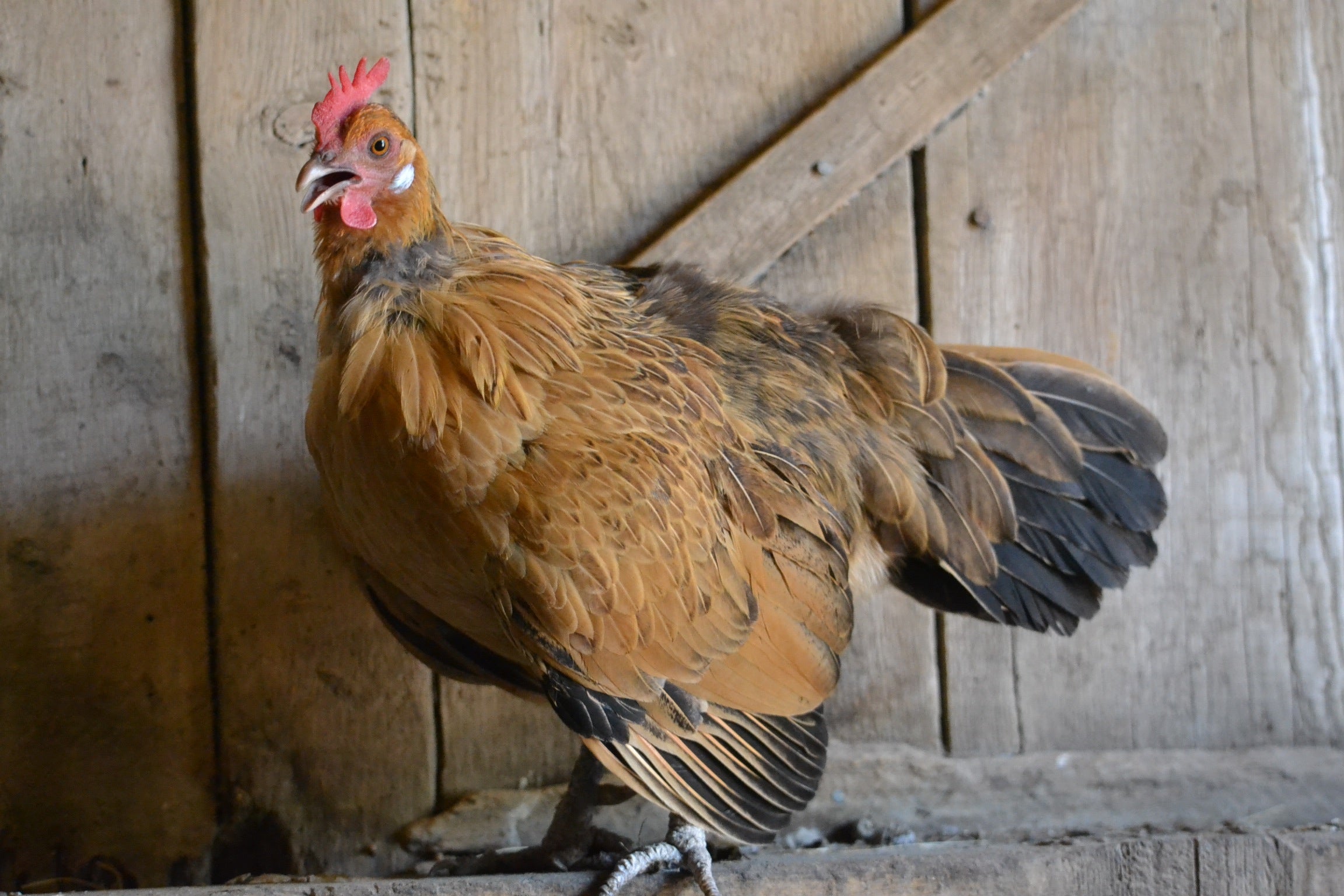
BREED OF THE DAY- MARSH DAISY

The Marsh Daisy is a rare breed due to interbreeding and World War II and is listed as endangered by the Rare Breed Survival Trust. They are large fowl of gentle and calm nature which arose from a complicated series of cross-breeding which started with an Old English Game bantam cockerel and some Malay hens in Lancashire, 1880's. 


(Marsh Daisy- Female)

Marsh Daisies are of very traditional appearance and is found in Wheaten and Brown varieties (gorgeous combinations of gold, black and brown colouring). They have rose combs with red eyes, face and wattles. They have hackle feathers at the neck which rest at the shoulders. In addition, they often have white ear lobes and beautiful featherless willow-green legs. Marsh Daisies are calm but active and are good flyers when bothered- so wing clipping is often recommended.

The eggs are medium sized and have a tinted white shell. The Marsh Daisy is a good forager and enjoys space therefore free range is highly recommended (they do not mind wet weather). However, these birds are not economical as the hens are slow to mature and produce eggs despite their good laying capabilities. Because of their rarity, it is important when considering this breed to find a well-established breeder that believes in their conservation.

 Summary: 
  •   Eggs: up to 200 a year!
  • Colourings: Wheaten and Brown (there’s is Buff, Black and White but these varieties are believed to be close to extinction)
  •   Character: Calm but flighty
  •  Weight: Female + Male around  2.5 kg


* *IF YOU HAVE ANY MORE INFORMATION ON THIS BREED YOU WOULD LIKE TO ME TO ADD TO THIS POST PLEASE MAKE A COMMENT BELOW*


BREED OF THE DAY- BARNEVELDER


The Barnevelder is a hardy breed that lays beautiful dark brown eggs. It is a relatively new breed as it name originates from a town in the Netherlands and was imported into Britain in the 1920’s. Barnevelders are thought to be a result of crossing local fowl with the Brahma, Langshan and Malay. They were originally bred for their winter laying capabilities and their large eggs. Unfortunately, over time the selective breeding for the desired dark brown egg shell has meant their productivity has decreased over the years. Even so as the hens become older their egg shell colour tends to become of a lighter brown, nevertheless 170 eggs can still be expected each year from a healthy hen in her prime. 

There are bantam versions available but the popularity of this stunning black laced bird began to fall with the increase in desire for sturdy hybrid layers. Barnevelders however, are still robust, good foragers and calm. They are quick to grow and their sexes can be identified at an early stage with day old male chicks having a white breast. Although, as the males become older they do not express the double lacing pattern but instead are black breasted reds.

(A female Barnevelder pullet)


The Barnevelder is a type of large fowl and has a plump soft feathered body. A female should be around 3kg and a male around 3.4 kg. It has a single bright red comb on an un-feathered face with orange eyes. There are other less recognised variations of the typical black and brown double laced feathers with a greenish sheen such as a blue-grey variance on the black colouring.


The bird was bred to be robust and docile and is suitable for beginner chicken owners. Because of their good nature it is important to take extra care when being placed in a mixed flock as younger chicks are prone to bullying. 

Summary:
  • Eggs: Dark brown – 170 a year
  • Colourings: Black double laced, with blue and white variants
  • Character: Docile and robust
  • Weight: large, female typically at 3kg


* IF YOU HAVE ANY MORE INFORMATION ON THIS BREED YOU WOULD LIKE TO ME TO ADD TO THIS POST PLEASE MAKE A COMMENT BELOW*

Broken eggs

Are you finding cracked eggs in your nesting box?  This is a fairly common problem and by following these solutions you should soon have nothing to worry about!  There are a number of reasons for broken shells.

1. Your chickens are not having enough calcium in their diet therefore producing shells that crack easily. This is quite an easy problem to solve. Simply buy some specially made oyster shell and this will help the chicken’s deficiency.
2. There could be too many chickens in one egg box. Overcrowding can could extra pressure on the eggs’ shell and force them to break. There should be about no more than four hens for each nesting box. If there is one box that is favoured over the others try and darken that area as it will prevent overcrowding. Also remember to collect the eggs every day!
3.Are your hens bored? Chickens who free range appear to be lee susceptible to egg breaking. Possibly because they are more busy e.g. digging for worms. In this case, try hanging fresh food e.g. cabbage from the top of the coop (so they have to jump to reach it). Alternatively you may purchase a pecking block which would also help any calcium deficiencies.
4.If you find it’s your hens pecking at the egg therefore cracking them try removing the eggs as soon as possible and replace with fake eggs.
Please comment if you have any questions. Good Luck!

Broody Time!

I often caught my hens in the act of laying. But, if you start to notice one sitting in the nest box without laying you may find your hen is broody. Being broody is when your hen decides she needs to incubate her eggs so that they can hatch (otherwise known as going into motherly mode!). Even if you pick her up from the box she will resist to move and may even 'wing flap' or peck (this is defence for her eggs)!  However, unfortunately for many keepers they do not want this. There are many reasons may you may not want this e.g. the eggs may not be fertilised, there will be a reduction in egg laying in your hen even after she has been broody, she is disrupting the other hens from laying, the cost of buying a broody box and finally you may not want to cope with a weak hen ( due to lack of food). When a hen is broody she will only leave her nest once a day for some food and water this is why you hen may not seem healthy or have a pale comb.

Symptoms:
  • Cuckoo sounds from the hen
  • Feathers fluffed out, more particularly around her tail
  • Not wanting to move much and looking hesitant to dust bathe or dig
  • Looking around to sit down
  • Constantly sitting in her nesting box
  • Laying no eggs
  • Warmer weather (increases the risk)

So how can you prevent this?
Make sure you remove the eggs from the box every day then she will not have the temptation. This is also important to prevent the cracking of eggs which the hens may develop a taste for. However, it is harder to prevent broodiness in the spring/summer because this is normally their laying season.

How to stop it?
I often found one of my hens was broody, some breeds are more attached to their eggs then others. Many suggest to put a cool pack beneath the chicken to make it seem colder (therefore she might realise that it is to cold to lay). Some people suggest to even dip the hen in to some water (I do not know about this method because I have not tried it!). However, I found the easiest way was to shut her outside the nesting box during the day until she was clearly put off (until she was acting normal again), this normally lasted a couple of days. This did include nighttime where I would shut the other two chickens into the coop box and leave the broody hen in the coop run. This may seem very mean at first, but I found it was the only method that did the trick. Also, it is not nice for the other hens trying to lay their eggs in the same nesting box (causing overcrowding and crushed eggs).

Plastic Coops

Every chicken lover should know that there are plastic chicken coops such as the Eglu (made by Omlet) on the market.I ended up buying an Eglu Go due to Red Mite, my problems with this pest was endless due to small hiding places between the sides of the wooden coop. Buying a plastic coop was an expensive but effective solution as there are no places for the mite to hide and even then can just be hosed off in a summer clean.

Advantages:
  • Being clean- as being plastic you can really quickly hose down that dirt
  • No Wood Treatment- prevent that yearly cost of wood treatment
  • Long Life- Plastic is more durable than wood
  • Removable Plastic perches, which means you can keep the underside clean and remove parasites
  • Insulation
  • PREVENTS RED MITE - a non porous surface prevents these little blighter
  • Some are made from recycled plastic adding that extra ECO feel to your house and garden


However, bear in mind the plastic does cost a huge amount more and their appearance may not suit your traditional liking! They are more suitable for domestic keepers because of this.


Websites:
http://www.plasticchickenhouse.co.uk/
http://www.omlet.co.uk/homepage/
http://www.poultry.allotment.org.uk/chicken-coop-ark/recycled-plastic-chicken-coops.php